

Macros For Muscle Gain: The Ultimate Nutritional Guide
Macros For Muscle Gain: The Ultimate Nutritional Guide For 2025
What Are Macros and Why Do They Matter for Muscle Gain?
Before diving into the numbers, it's crucial to understand the fundamentals. Macronutrients, or "macros," are the three primary nutrients your body needs in large amounts to function: protein, carbohydrates, and fats. Each plays a distinct and vital role in your quest to build muscle.
While calories determine your overall weight gain or loss, your macro split dictates the *quality* of that change. Simply eating more calories without the right macro balance can lead to unwanted fat gain instead of lean muscle. For muscle growth (hypertrophy), you need to provide your body with the right raw materials to repair and build tissue, fuel intense workouts, and support hormonal function. This is where a targeted macro strategy becomes your most powerful tool.
Think of it like building a house. Calories are the total budget, but macros are the specific materials—protein is the bricks and mortar, carbs are the electricity for the power tools, and fats are the insulation and wiring. You need all three in the right proportions to build a strong, functional structure.
Step 1: Establish a Calorie Surplus for Lean Gains
The first law of building muscle is energy balance. To build new tissue, your body requires more energy (calories) than it burns. This is known as a caloric surplus. However, a common mistake is creating too large a surplus, which fast-tracks fat storage alongside muscle.
A smart, sustainable approach is to aim for a modest surplus of 250-500 calories above your daily maintenance level. This provides enough extra energy to fuel muscle protein synthesis without overwhelming your body's ability to build lean mass, thus minimizing fat gain. This controlled approach is key to a successful "lean bulk."
Figuring out your maintenance calories can be complex, as it depends on your age, weight, height, activity level, and body composition. To get a precise, science-backed starting point, we highly recommend using the MealPrepTools.com Macro Calculator. It takes the guesswork out of the equation and gives you a personalized target to build from.
Protein: The Essential Building Block for Muscle
Protein is the undisputed king of macros when it comes to muscle gain. It's made up of amino acids, which are the literal building blocks your body uses to repair the microscopic tears in muscle fibers caused by resistance training. This repair-and-rebuild process is what makes your muscles grow bigger and stronger.
Scientific consensus recommends a protein intake of 1.6 to 2.2 grams per kilogram of body weight (or about 0.7 to 1.0 grams per pound) for active individuals looking to maximize muscle growth. Hitting this target is non-negotiable. Falling short will compromise your recovery and limit your results, no matter how hard you train.
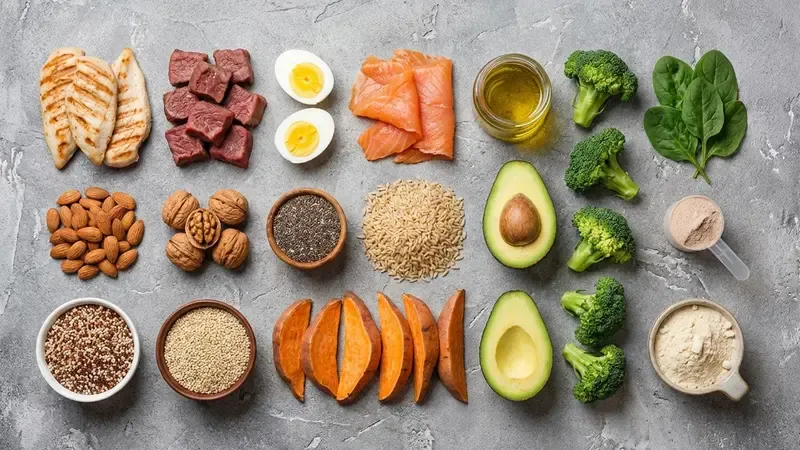
Prioritize high-quality, complete protein sources to ensure you get all the essential amino acids. Excellent choices include:
- Lean meats (chicken breast, turkey, lean beef)
Fish (salmon, tuna, cod)
Eggs and egg whites
Dairy (Greek yogurt, cottage cheese, milk)
Whey or casein protein supplements
Plant-based options like tofu, tempeh, edamame, and lentils
Carbohydrates: Fueling Your Performance and Recovery
Carbohydrates are your body's primary and most efficient energy source, especially for the kind of high-intensity activity required to stimulate muscle growth. When you consume carbs, they are broken down and stored in your muscles and liver as glycogen. This stored glycogen is the fuel you burn during your heavy lifts.
Having fully stocked glycogen stores allows you to train harder, lift heavier, and complete more reps, providing a stronger stimulus for growth. Carbs also play a role in recovery by helping to shuttle nutrients into your muscle cells and by stimulating insulin, an anabolic hormone that helps drive the muscle-building process.
After setting your protein and fat targets, you should fill the remainder of your daily calories with carbohydrates. For most people, this will fall in the range of 3-5 grams per kilogram of body weight. Focus on complex carbohydrates like oats, brown rice, quinoa, potatoes, and whole-grain bread for sustained energy throughout the day. Simple carbs, like fruit or a sports drink, can be beneficial around your workout window to provide quick energy and speed up glycogen replenishment.
Fats: Supporting Hormones and Overall Health
Dietary fat often gets a bad reputation, but it is absolutely essential for your health and your muscle-building goals. Healthy fats are critical for the production of powerful anabolic hormones, including testosterone, which is a key driver of muscle growth. They also play a vital role in vitamin absorption, cell membrane integrity, and reducing inflammation.
Neglecting your fat intake can lead to hormonal imbalances that will severely hamper your ability to build muscle and recover from training. A good guideline is to have dietary fats make up 20-30% of your total daily calorie intake. This ensures you're supporting your endocrine system without taking away too many calories from the protein and carbs needed for repair and fuel.
Focus on incorporating a variety of healthy, unsaturated fat sources into your diet. Top choices include:
- Avocados
Nuts (almonds, walnuts)
Seeds (chia, flax, pumpkin)
Olive oil
Fatty fish (rich in Omega-3s)
Putting It All Together: Your Ideal Macro Split
Now, let's combine these principles into a simple, actionable plan. You can calculate your target macros for muscle gain in four steps:
1. Set Calories: Use the Macro Calculator to find your maintenance calories, then add 250-500.
2. Set Protein: Multiply your body weight in pounds by 1.0 (or kilograms by 2.2) to find your daily protein goal in grams.
3. Set Fats: Calculate 25% of your total daily calories and divide that number by 9 (since fat has 9 calories per gram) to get your fat goal in grams.
4. Set Carbs: Add up the calories from your protein goal (grams x 4) and your fat goal (grams x 9). Subtract this total from your daily calorie target. The remaining calories are for carbs. Divide that number by 4 (carbs have 4 calories per gram) to get your carb goal in grams.
For example, for a 180 lb person with a 3,000-calorie target:
- Protein: 180 lbs x 1.0 g/lb = 180g (720 calories)
Fat: 3000 cals x 0.25 = 750 cals. 750 / 9 = 83g of fat.
Carbs: 3000 - (720 + 750) = 1530 cals. 1530 / 4 = 383g of carbs.
This manual calculation illustrates the process, but the MealPrepTools.com Macro Calculator does all this work for you in seconds, giving you a perfect starting point.
From Numbers to Plates: Meal Prepping for Success
Knowing your macros is one thing; consistently hitting them is another. This is where meal prepping becomes a game-changer. By planning and preparing your meals in advance, you eliminate guesswork and decision fatigue, making it simple to stick to your nutritional plan even on your busiest days.
Meal prepping ensures you have macro-balanced meals ready to go, preventing you from reaching for unhealthy, convenient options that can derail your progress. It allows you to control portion sizes with precision, which is crucial for staying within your calorie and macro targets.
To make this process even easier, you can plug your macro targets into our Meal Planner tool. It helps you build a daily and weekly eating schedule that aligns perfectly with your goals. From there, our Grocery Generator can create a complete shopping list based on your planned meals, streamlining your entire prep process from start to finish.
Key Takeaways
- Establish a modest calorie surplus of 250-500 calories above maintenance to fuel muscle growth while minimizing fat gain.
- Prioritize protein intake, aiming for 1.6-2.2 grams per kilogram (0.7-1.0 g/lb) of body weight daily.
- Fill the rest of your calories with carbohydrates to fuel intense workouts and fats to support hormone production.
- Aim for a macro split of roughly 40% carbs, 30% protein, and 30% fat, but adjust based on your personal needs.
- Use the MealPrepTools.com Macro Calculator to get personalized targets without doing complex manual math.
- Leverage meal prepping to ensure you consistently hit your macro numbers day in and day out.
- Consistency in both your training and your nutrition is the ultimate key to long-term muscle gain.

